Market Brief · by Aidan Sowa · October 5, 2026
Is Sunset Park a Waterfront Neighborhood or a Flood-Relief Project? Reading the Canal Frontage, the Owner Share and the Metro Clock
Reading the Canal Frontage, the Owner Share and the Metro Clock for Sunset Park, FL, with each source dated and its limits noted, for owners weighing a listing against a direct sale.
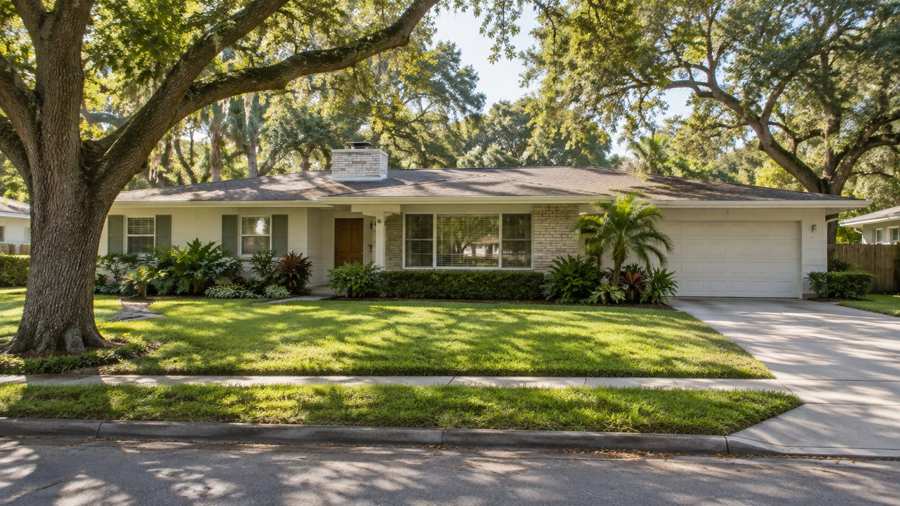
A Sunset Park owner who tries to size up the neighborhood from public information will find two stories running side by side. One is a waterfront story: canals, docks, bay views and a park with a boat ramp. The other is a public-works story, with water mains being replaced, sewers rehabilitated, traffic signals upgraded and flood relief planned along a canal. A seller has to decide which of the two a buyer is likely to weigh more, and whether a public listing is the best way to find out.
This brief takes the question in four parts. First, what the city and local agents say about the neighborhood itself. Second, what the Census shows about the people and homes in the postal area that contains Sunset Park, particularly ownership, income and rent. Third, what the Tampa metropolitan listing data say about how long homes wait and how many have cut their price. Fourth, what an owner avoids by selling directly to a private buyer.
A caution applies throughout. Census figures describe a postal delivery area that reaches beyond the neighborhood, and the listing series cover three counties. Where a statement is only true of that wider area, the text says so, and where a claim comes from a brokerage's marketing, it is labeled as commentary.
Key Findings
- Of the 11,330 housing units in the postal area, 8,610 are occupied by their owners (76.0% of all units and 80.1% of occupied homes), 2,136 are rented and 584 (5.2%) have no usual resident (U.S. Census Bureau, 2020-2024).
- Median household income in the area is $164,355 and median gross rent is $1,891 a month, so a renter at the median spends 13.8% of income on rent.
- The City of Tampa lists water-main replacement, sewer rehabilitation, signal upgrades and flood-relief work tied to Lamb Canal among its projects in the Sunset Park area, according to a local agent's May 2026 guide (a South Tampa agent, 2026).
- The Tampa-St. Petersburg-Clearwater metropolitan median listing waited 76 days in September 2026, up from 67 in May (Realtor.com, days on market).
- In May 2026, the last month the series reports, 7,596 of the metropolitan area's 17,967 active listings had cut their price, or 42.3% (Realtor.com, price reductions).
What makes Sunset Park a waterfront neighborhood?
Sunset Park sits on the Old Tampa Bay side of the South Tampa peninsula. A South Tampa agent's May 2026 guide, which draws on City of Tampa pages, says the neighborhood is known for two things at once: its waterfront setting and its street names, which honor famous poets. It describes the area as mostly residential, with established roots and mature streets, and not the uniform feel of a master-planned community.
A second brokerage comparison puts Sunset Park next to its neighbor Beach Park and says both offer canal-front homes, private docks and a mix of original houses and elevated new construction (a Tampa agent's comparison). The shared point of both sources is that the housing is not of one kind. The guide lists waterfront homes, inland single-family houses, condominiums, townhomes, houses from the 1920s and the mid-twentieth century, and some new construction.
The same guide notes the neighborhood's tree cover. The City of Tampa's 2021 canopy analysis, it says, puts Sunset Park at about 50% canopy. The nearest public water access is Ballast Point Park, which the city describes as having a boat ramp that is open around the clock, a dock, picnic areas, a splash pad and a pier with views across Hillsborough Bay toward downtown. The guide also notes that trailer parking is limited and that the city's park page has mentioned hurricane-related closures of the pier and the fitness center.
These are marketing descriptions, written to attract buyers, and they leave out the costs. They are still useful for one reason. They show what a buyer is told the neighborhood is for: boating, bay views and a quiet residential street within reach of Bayshore Boulevard and downtown. Those are the features a seller would expect an offer to be built around.
What is the city doing about water and flooding here?
The guide's section on infrastructure is the part a buyer is least likely to find on a listing sheet. It says City of Tampa information shows ongoing work in the Sunset Park area: water-main replacement, sewer rehabilitation, traffic-signal upgrades near Manhattan Avenue and Bay to Bay, and flood-relief work tied to Lamb Canal. The guide treats these as signs of investment. A buyer who lives on a canal or near the bay can read the same list as a reminder that the area has water problems that need public money.
Neither reading is wrong. Flood relief is built where flooding is a concern, and it also reduces the concern once complete. For a seller, the practical point is that a careful buyer will ask about flood zone, elevation, past water entry, insurance cost and the status of the canal project. The Census data used in this brief cannot answer any of those questions, and no statistic in it should be read as a statement about flood risk for a particular house.
The details that decide value in a neighborhood like this tend to be house-specific: the elevation of the lowest floor, whether the house sits on a canal or a street, the condition of a seawall if there is one, and the cost of insurance that a buyer would carry. A seller who can document these has an easier conversation with any buyer, public or private. A seller who cannot may prefer a buyer who accepts the house as it stands and does the diligence on their own side.
A last point concerns timing. Public works projects take years, and a buyer who reads the city's list in the spring may expect conditions to improve by the time they own the house. That expectation can support the price. It can also fade if a project is delayed, and the seller should not count on it.
Who owns the homes in the postal area, and what do they earn?
The Census counts 11,330 housing units in the postal area that holds Sunset Park, with a population of 27,710. Of the 10,746 occupied homes, 8,610 are occupied by their owners. That is 80.1% of occupied homes and a higher owner share than in many urban districts. Another 2,136 homes are rented, 19.9% of the occupied stock. Only 584 units, 5.2% of the total, have no usual resident, so the area is lived in year round and is not a seasonal market.
Median household income is $164,355, with a margin of error of $15,351 on the estimate, and median gross rent is $1,891 a month. At that rent a household pays $22,692 a year, which is 13.8% of the median income. The income figure is for all households in the area, owners and renters together, and the owners are very likely to sit above the median.
For a seller, the owner share says something about the neighborhood's pace. A district where four in five occupied homes are owned has fewer rental turnovers, and many of its sales come from owners deciding for personal reasons to move: a change of job, a growing or shrinking family, a retirement, an estate. Those sellers often have a date they care about, and they often care about keeping the sale quiet from neighbors they have known for years.
The postal area contains neighborhoods beyond Sunset Park, so these averages do not describe a block. Canal-front homes are likely to differ from the rest in value and in ownership, and the Census tables used here do not break them out.
| Indicator | Value | Note |
|---|---|---|
| Population | 27,710 | Whole postal area |
| Housing units | 11,330 | All units |
| Owner-occupied homes | 8,610 | 80.1% of occupied homes |
| Renter-occupied homes | 2,136 | 19.9% of occupied homes |
| Units with no usual resident | 584 | 5.2% of all units |
| Median household income | $164,355 | Margin of error $15,351 |
| Median gross rent | $1,891 a month | 13.8% of median income |
Source: U.S. Census Bureau, American Community Survey 2020-2024 five-year estimates, tables B01003, B19013, B25003 and B25064.
How long do Tampa listings wait, and how many have cut their price?
The Realtor.com series for the Tampa-St. Petersburg-Clearwater metropolitan area are the nearest public measure of how the market moves. They cover three counties, so they describe the typical listing in the region and not a canal house in Sunset Park. The median listing spent 76 days on the market in September 2026, against 67 in May, an increase of 9 days or 13.4%.
Active listings barely moved. There were 17,967 in May and 17,965 in September, a change of two listings. A flat count with longer waits means that new listings and sales have been in rough balance, but each listing is staying longer before it sells. In other words, the stock is turning over more slowly.
The price-reduction series is the one that stopped early. Its last reading is May 2026, when 7,596 listings carried a cut, down from 7,824 in April and 7,938 in March, though up from 7,482 in February and 7,004 in January. Relative to the 17,967 active listings of that month, the cut share is 42.3%, so more than two in five listings had been reduced by the end of the latest period reported. The series for later months was not available in the data used, and this brief does not estimate it.
The measures together describe a market in which sellers are often adjusting their expectations and buyers are taking their time. They do not say how a specific house will fare. A waterfront property with a dock might attract a different buyer from an inland bungalow, and the typical listing tells us little about either.
Source: Realtor.com via FRED, Housing Inventory: Median Days on Market, Active Listing Count and Price Reduced Count, Tampa-St. Petersburg-Clearwater, FL (CBSA).
Why does the mix of old and new houses matter to a seller?
The guide and the comparison both describe a neighborhood where original houses stand next to elevated new construction. That mix creates a particular problem for anyone trying to price an older house from nearby sales. A new house built to current flood standards, on pilings or a raised slab, is a different product from a 1920s bungalow at ground level, even when the two share a street and a view of the water. Sale prices for the two cannot be averaged without losing the point.
For the owner of an older house, buyers tend to arrive with one of two plans. Some will live in the house and renovate it over time, and they will price the work they can see. Others will rebuild, and for them the value lies in the lot, its frontage and the rules that apply to a new structure. The second group generally pays attention to the elevation and flood requirements for new construction, since those control the cost of the house that replaces yours. An owner who does not know which kind of buyer is likely to appear cannot know which part of the house the price will rest on.
The tree canopy that the guide mentions adds one more layer. Mature trees are an asset for a buyer who wants a shaded, settled street, and a constraint for a buyer who plans to build, since removing or working around large trees can involve permits and cost. The guide does not say how the city handles trees on private lots, and this brief does not guess. An owner who is uncertain should ask the city's permitting office before assuming anything.
The conclusion for a seller is not to wait for clarity that will never arrive. It is to recognize that the same house is worth different amounts to different buyers, and that a process which reaches only the people who see a sign in the yard samples a small part of them. A direct buyer who evaluates the house as it stands, for the lot and the structure together, is one more point of comparison, and it can be obtained without a listing.
What does a waterfront seller risk in a public sale?
A public sale of a waterfront house exposes the owner to a set of delays that the owner of an inland house might avoid. Buyers ask for a survey of the seawall and dock, an elevation certificate and a flood insurance quote before they commit, and each takes time and money. A lender or insurer may add conditions. If one of them raises a problem late in the process, the price is reopened, and the owner has already told the neighborhood that the house is for sale.
A private direct sale to a buyer such as Maison Off-Market changes that sequence, and the five benefits show how. The first is privacy: no showings, and no neighbors talking about you selling, which matters on a street where people know which house has a boat lift. The second is a flexible closing date, so an owner who has not found the next home can set the date to suit. The third is no commission. The fourth is no closing costs. The fifth is avoiding inspections and repairs, so the seawall, the roof and the dock are bought as they stand.
The commission item can be sized without assuming a rate. Each 1% of the Census median owner estimate of $851,400 is $8,514. Each 1% of a $1.5 million waterfront house would be $15,000. A commission at any ordinary rate is a multiple of those amounts. This is arithmetic on round numbers and is not a quote or an offer.
The tradeoff is the usual one. A public listing in a good week can attract competing bids for an attractive canal house, and a private sale offers one buyer's terms. An owner who is confident that a competitive bid would arrive should list. An owner who weighs privacy, a flexible date and the avoidance of repairs more highly than a possible premium has a reason to ask for a private offer first and compare it with what a listing would net. Readers comparing markets can also read the Palma Ceia brief and the Old Naples brief.
What should an owner collect before talking to any buyer?
Whether the owner chooses a listing or a direct sale, a short file of facts makes the conversation easier and the offers easier to compare. The most useful items for a waterfront house are the flood zone designation and the elevation of the lowest floor, any insurance claims in the last ten years, the age and condition of the seawall and dock, the roof age, and a list of improvements with dates. The property tax bill shows the assessed value and the annual cost, and the homeowner's insurance policy shows what the carrier charges for wind and flood.
These documents also tell the owner something. A house with a recent elevation certificate and clean claims history will draw buyers who ask fewer questions, and a house with a gap in the file will draw buyers who ask more. The owner can decide, before any buyer appears, whether the gaps are worth closing or whether it is simpler to sell to someone who will take the house as it is.
The owner should also write down the date by which the sale must close and the minimum net amount that would make the sale worthwhile. With those two numbers fixed, each offer can be measured against them, and the choice between public and private routes becomes a comparison of the money and time each would produce, not a matter of preference alone.
Methodology and limitations
Ownership, income, rent and population come from the American Community Survey 2020-2024 five-year estimates, tabulated for the postal-code area that holds Sunset Park. The area approximates a postal delivery area and includes neighboring districts, so the figures describe the area, not the neighborhood alone. Percentages are calculated from published counts and rounded to one decimal place. Margins of error are those published by the Census Bureau at the 90% confidence level.
Days on market, active listings and price-reduced listings are Realtor.com series published through the Federal Reserve Bank of St. Louis for the Tampa-St. Petersburg-Clearwater metropolitan area. The price-reduction series ends in May 2026. The cut share of 42.3% divides the May cut count by the May active count. Listing prices are asking prices, not sale prices.
Descriptions of the neighborhood, the city's projects and the canopy figure are quoted from a local agent's guide and a second agent's comparison, which are marketing content by parties that earn fees from sales. The guide in turn cites City of Tampa pages that were not independently re-read for this brief. The brief makes no forecast and does not estimate what any particular house would sell for.
Conclusion
For an owner in Sunset Park, the public record supports a few narrow conclusions. The postal area is mostly owner-occupied and lived in year round, household income is high, the city has several water and flood projects under way in the area, and the Tampa metropolitan market has slowed since May, with longer waits and, as of the last reading, a large share of listings carrying a price cut.
It does not support a price for a particular house or a forecast. Time is also a factor for a household that has already bought its next home, since each extra month of listing is a month of two sets of costs. The Sunset Park owner who has the elevation certificate, the insurance history and the closing date in hand is in the best position to compare offers. The choice between a public listing and a private sale depends on how much an owner values a possible higher price against privacy, a flexible closing date, no commission, no closing costs and no inspections or repairs. Any owner can test these points by asking for written terms from more than one buyer and comparing the net amount, the closing date and the conditions side by side, which is the clearest way to see what a house is worth to real buyers.
Frequently Asked Questions
Do the Census figures describe only Sunset Park?
No. They describe a postal delivery area that includes Sunset Park and its neighbors, so they are context and not a statement about one street.
Does the city flood-relief work lower flood risk for my house?
The public sources used here do not say. Flood risk is specific to a property's elevation and location, and an owner should rely on an elevation certificate and insurance quote.
Why is the price-reduction figure from May?
The Realtor.com series for the Tampa area stopped updating after May 2026 in the data used, so the brief uses the last available month and says so.
Is the Tampa metropolitan data a good guide to a canal house?
Only a rough one. It covers three counties and all property types, so a waterfront house can behave differently.
Does a private sale always beat a public listing?
No. A public listing can attract competing bids and sometimes a higher price. A private sale offers privacy, a flexible closing date, no commission, no closing costs and no inspections or repairs, in exchange for a single offer.
Compare your options before committing. Request a written private offer for your property, with no obligation, then weigh it against your listing plan.
Sources
- U.S. Census Bureau, 2026. American Community Survey 2020-2024 five-year estimates, the Sunset Park area (via Census Reporter). https://censusreporter.org/profiles/86000US33629-33629/.
- South Tampa agent (Kristen Richards), 2026. Sunset Park Tampa Waterfront Guide: Is It Right for You?. https://kristenrichards.com/blog/exploring-sunset-park-waterfront-living-in-tampa.
- Realtor.com, 2026. Housing Inventory: Median Days on Market in Tampa-St. Petersburg-Clearwater, FL (CBSA). https://fred.stlouisfed.org/series/MEDDAYONMAR45300.
- Realtor.com, 2026. Housing Inventory: Price Reduced Count in Tampa-St. Petersburg-Clearwater, FL (CBSA). https://fred.stlouisfed.org/series/PRIREDCOU45300.
- Tampa agent (Shane Vanderson), 2026. Beach Park vs. Sunset Park: South Tampa Buyer Comparison. https://shanevanderson.com/blog/beach-park-vs-sunset-park-how-south-tampas-two-waterfront-neighborhoods-compare.
Related research
Seller Guide · October 6, 2026
How to Prepare Point Pleasant Beach Rental Records Before Selling
Separate rental approval, income history and booked stays before comparing sale terms.
Seller Guide · October 6, 2026
How to Prepare Rumson Flood and Waterfront Records Before Selling
Separate flood disclosure, elevation, repairs and waterfront rights before comparing sale terms.
Seller Guide · October 6, 2026
How to Prepare Sarasota Condo Inspection and Reserve Records Before Selling
Separate building condition, reserve funding and resale documents before comparing sale terms.