Market Brief · by Aidan Sowa · October 5, 2026
Does Paradise Valley Price Land by the Acre or by the Slope? Reading the Hillside Line, the Record Sale and the Middle Wait
Reading the Hillside Line, the Record Sale and the Middle Wait for Paradise Valley, AZ, with each source dated and its limits noted, for owners weighing a listing against a direct sale.
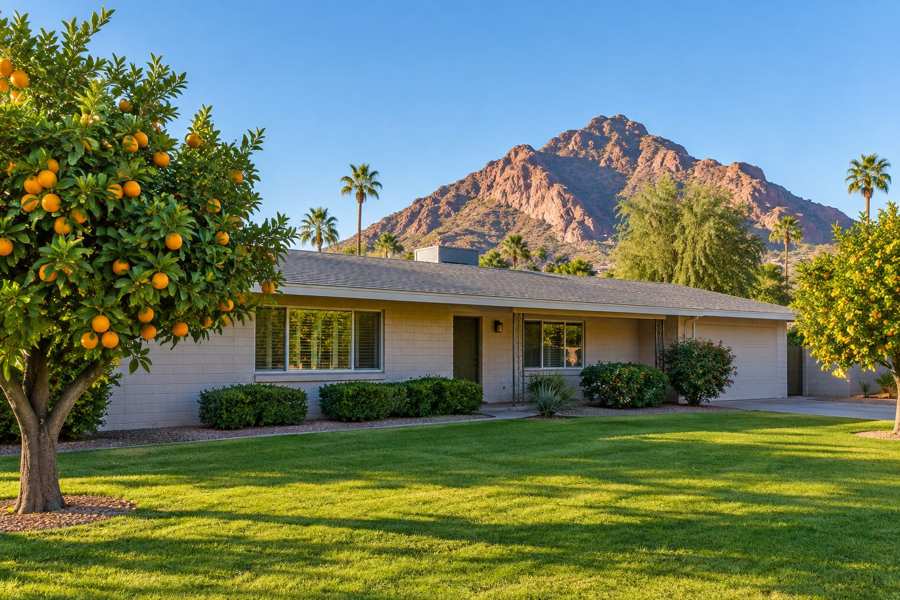
A seller in Paradise Valley is told by every listing sheet how many acres the lot holds. A Scottsdale brokerage's August 2026 article says the acre is not what sets the price. Slope is. Once a lot's natural grade reaches 10 percent, the town's hillside rules limit how much of the ground an owner may disturb, and the steeper the site, the smaller the share. Two lots at the same price can support very different houses.
This brief takes that point and sets it beside the rest of the 2026 record: a state-record sale in July, a middle tier that was cooling in the spring, a fall luxury report that shows the median falling while the price per square foot rises, the Census age and tenure profile of the town's single postal area, and the Phoenix metropolitan listing series. It then asks what a private direct sale changes for an owner who would rather not run a long listing in a thin market.
The limits are plain. The Census value figure is top-coded, the brokerage figures are marketing content, and the Phoenix metropolitan series cover a region far larger than the town. The brief says where each limit applies and does not estimate what any particular property is worth.
Key Findings
- The town's hillside rules apply once natural grade reaches a 10 percent slope and cap disturbed area at up to 60 percent of the site at 10 percent slope, about 34 percent at 15 percent and roughly 13 percent at 25 percent; raw land has traded between $1.5 million and $5 million or more an acre in 2025 and 2026 (Jakobov Group, August 2026).
- A September 2026 article reports a $40.24 million all-cash sale in July, the highest in Arizona history, while active single-family inventory in the postal area rose 42 percent from 304 to 431 listings between April and June, with days on market reaching 121 in May (Gillette Group, September 2026).
- A fall report puts the town's median sale price at $4,197,716 in June, up 0.5 percent, and the postal-area three-month median at $3.6 million, down 1.7 percent, with the price per square foot at $847, up 26 percent (Hague Luxury Network, September 2026).
- In the Census postal area that includes Paradise Valley, 6,462 of 7,654 occupied homes (84.4%) are owner-occupied and 1,497 of 9,151 units (16.4%) have no usual resident (U.S. Census Bureau, 2020-2024).
- The Phoenix metropolitan median days on market was 60 in May 2026 and 62 in September, after peaking at 67 in July and August (Realtor.com, days on market).
What does the 10 percent line do to a lot?
The August article explains the rule in plain terms. The town's hillside development regulations, part of its zoning ordinance, apply once a lot's natural grade reaches a 10 percent slope. Below that line the ordinance mostly stays out of the way. Above it, the town decides how much of the owner's land may be touched. The mechanism is a cap on disturbed area, meaning any ground altered by grading, cutting, filling, clearing native vegetation or trenching. The steeper the site, the smaller the share that can be disturbed.
The article gives the figures: up to 60 percent of the site at a 10 percent slope, about 34 percent at 15 percent, roughly 13 percent at 25 percent and single digits beyond 50 percent. It adds a detail that surprises sellers. The town does not average a lot's slope. It regulates by the steepest condition it finds, so a wash cutting across an otherwise flat lot can pull the whole parcel into hillside review.
Two listings that year, it says, told opposite stories about the same word. One was a 2024-built estate on a north slope, listed in April 2026 at $10.75 million, whose marketing leaned on elevation and views. The other was a flat lot from the 1970s whose entire pitch was that it had no hillside ordinance and no association. The market already understands the difference, the article argues, and buyers who do not find out late.
For an owner, the first practical step is to know which side of the line the lot is on. A flat lot has a full building envelope and a buyer can plan a larger house. A sloped lot may carry a smaller envelope than its acreage suggests, and a buyer who has read the ordinance will price that in. A seller who has the numbers ready can answer the question before it becomes a discount.
| Building-site slope | Maximum disturbed area |
|---|---|
| 10% | Up to 60% of the site |
| 15% | About 34% |
| 25% | Roughly 13% |
| Beyond 50% | Single digits |
Source: Jakobov Group, August 27, 2026. The brokerage describes the town's zoning ordinance; the ordinance text was not independently verified.
What is raw land worth, and why does a per-acre figure mislead?
The same article says raw land has traded between $1.5 million and $5 million or more per acre over 2025 and 2026, depending on location, view corridor and topography. A range that wide is not a price. It is a warning that the acre is the wrong unit. A one-acre flat lot and a one-acre slope may differ by the amount of house each can hold, and the buildable area is what a builder pays for.
A buyer who plans to build will do a simple calculation, whether or not they state it. They take the buildable envelope, subtract the cost of the engineering a hillside needs, and compare the result with the land price. A flat lot spares them the engineering. A steep lot may offer views that justify the cost, but the cost is real and sits in the offer.
An owner of an older house on a large lot is in an interesting position. If the lot is flat, the house may be worth less than the land under it, and a buyer will be pricing a teardown. If the lot is sloped, the existing house may already occupy the most buildable part, and replacing it may be harder than it looks. In both cases the structure is not the main asset.
None of this fixes a value. The article's range is a range, and the Census data below show that the town's homes are older than a new-build image suggests. What the range does tell a seller is that an offer expressed per acre needs a follow-up question: per buildable acre, or per acre of ground?
Source: Jakobov Group, August 27, 2026. Brokerage content, not independently verified.
Who lives here, and how old are the homes?
The postal area has 17,904 residents and 7,654 occupied homes. Owners occupy 6,462 of them (84.4%) and renters occupy 1,192 (15.6%). Another 1,497 units, 16.4% of the 9,151 total, have no usual resident, which fits a town where a number of owners spend the summer elsewhere. Median household income is $184,979 and median gross rent is $2,018 a month.
The Census reports the owner-estimated median home value as $2,000,001, which is the top code of the survey. It means that more than half of owners put their homes at $2 million or more, and that the survey cannot say how much more. The town's median sale price of $4,197,716 in June, reported by the fall report, is more than twice the top code. The Census figure here is a floor, not a median.
By age, the 1970s are the largest decade with 1,791 homes (19.6%), followed by the 1980s with 1,612 (17.6%) and the 1990s with 1,268 (13.9%). The 2000s and 2010s each added about 1,200 to 1,300 homes, and 255 have been built since 2020. Homes built before 1980 total 3,534, 38.6% of the stock, and the median year built is 1986.
That is a stock of large mid-century and late-century houses on acre-plus lots, many of which have been updated and some of which have been replaced. The fall report says that when more transactions occur in smaller, finished, current homes and fewer in the largest dated estates, the median can fall while the per-foot price rises. An owner with a dated estate is in the second group.
| Indicator | Value | Note |
|---|---|---|
| Population | 17,904 | Whole postal area |
| Housing units | 9,151 | All units |
| Owner-occupied homes | 6,462 | 84.4% of occupied |
| Renter-occupied homes | 1,192 | 15.6% of occupied |
| No usual resident | 1,497 | 16.4% of all units |
| Median household income | $184,979 | Estimate |
| Median gross rent | $2,018 | Monthly |
| Owner-estimated median value | $2,000,001 | Top-coded; true median is higher |
Source: U.S. Census Bureau, American Community Survey 2020-2024 five-year estimates, tables B01003, B19013, B25003, B25034, B25064 and B25077.
How can the top and the middle move in opposite directions?
The September article describes a market running two stories at once. At the top, it counts ten homes above $10 million closing in January and February alone, against nineteen in all of 2025, a $12.25 million cash sale on February 27 that set a resale record of $1,938 a square foot, and three all-cash sales above $20 million within ten days in March. Then, in July, a 20,919-square-foot estate closed for $40.24 million in cash, which the article calls the most expensive home sale in Arizona history. It adds that the market was seeing roughly twice as many closings at $2,000 a square foot as the year before.
In the middle, the article says, the opposite happened. Between April and June, active single-family inventory in the postal area jumped 42 percent, from 304 to 431 listings. Days on market rose from 97 in April to 121 in May. Months of supply reached 10.3, which it calls the strongest buyer position in eighteen months. With about 5,800 households in the town, 431 listings means roughly 7 percent of homes were for sale at once.
A table in the article sets the tiers side by side. The trophy tier of $10 million and up frequently went off the market within 30 days, at $1,798 to $1,938 a foot. The middle tier of $2 million to $5 million took 121 days in May and sold at a median of $987 a foot, with older stock built in 2019 or earlier closing near $795 a foot. Trophy buyers paid cash, often through an LLC, and the middle tier used a mix of cash and jumbo loans.
For an owner, the first question is which tier the house belongs to. A seller in the trophy tier is in a market that, by this account, does not negotiate. A seller in the middle is in a market where patience rewards buyers. The article also notes that the town closes only 40 to 60 homes a month, so a handful of large sales can move the median in any month.
Source: Gillette Group, September 24, 2026, which cites Compass Arizona and county records. Brokerage content, not independently verified.
Why does a thin market make one sale so loud?
The September article says the town closes something like 40 to 60 homes a month, compared with 800 to 1,000 each in Scottsdale and Phoenix. In a market that thin, a few sales above $20 million in the same month as a wave of $2 million listings that sit unsold can pull the median in whatever direction the trophy sales point. That is why national sites disagree so widely on the number, and why a single record does not change what a middle-tier house will fetch.
A record sale is real, and it does tell an owner something: there are buyers who will pay very high prices for the right property and who pay in cash. It does not tell an owner that the next sale will be near it. The $40.24 million sale was a 20,919-square-foot house built on speculation, and the article says its sellers reportedly sold to fund another home in town. It is one sale, between willing parties, at the top of one tier.
For most owners, the useful reading is the one the article makes about the middle: 431 active listings, 10.3 months of supply and a 121-day clock. Those figures describe the houses a seller is actually competing against. An owner who knows how many comparable houses are for sale, and how long they have sat, can tell whether a public listing would stand out or be one of many.
Source: Gillette Group, September 24, 2026. Brokerage content, not independently verified.
What does the fall report say about the median?
A second report, published in September, reads the same market through the median. It puts the town's median sale price at $4,197,716 as of June 2026, up 0.5 percent from a year earlier, and says Redfin calls the market not very competitive. For the postal area, it puts the three-month median at $3.6 million, down 1.7 percent, and the median price per square foot at $847, up 26 percent.
The report explains how both can be true. The median measures which houses sold, not what each is worth. When more transactions occur in smaller, finished, current homes and fewer in the largest dated estates, the median falls while the per-foot figure rises. Buyers are paying a premium per foot for the right product while the overall median softens because the composition of what sold changed.
It draws three conclusions for owners, and one is worth stating here. Presentation and pricing precision now carry more weight than exposure volume, because a market that is not very competitive gives buyers time to compare. In practice, buyers have time, choice and negotiating room, particularly on dated inventory, while sellers of current, well-presented estates still transact near their expectations.
Two other figures show how different sources can disagree. The Gillette article notes that one automated valuation put the typical home near $3 million while Redfin's median sale price for August came to about $4.3 million, up 4.1 percent. Neither is wrong, it says. They measure the market differently at a moment when the market is split. An owner who collects three numbers will find three answers, and should ask which houses each describes.
Source: Hague Luxury Network, Paradise Valley Luxury Market Report: Fall 2026, September 10, 2026, which cites Redfin, Freddie Mac and the Institute for Luxury Home Marketing; Gillette Group, September 24, 2026. Not independently verified.
What have the Phoenix series done since spring?
The Realtor.com series cover the whole Phoenix-Mesa-Scottsdale area, where the median asking price is about $475,000. They show direction, not the town's level. The median days on market was 60 in May, 64 in June, 67 in July and August and 62 in September. Active listings were 19,517 in May and 18,437 in September, a decline of 5.5 percent, with a low of 17,661 in July (Realtor.com, active listings).
New listings fell from 8,670 in March to 5,854 in July (Realtor.com, new listings), a decline of 32.5 percent. The median listing price slipped from $498,000 in May to $475,000 in September (Realtor.com, median listing price), a decline of 4.6 percent. Listings with a price reduction fell from 10,902 in March to 8,348 in July (Realtor.com, price reduced listings).
A metropolitan median of $475,000 and a town median above $4 million are not in the same market. The series are of no use for pricing a Paradise Valley estate. They do show that the region's clock stretched through the summer and that inventory rose in the autumn, which is the setting in which the article's middle tier sat for 121 days. Readers comparing markets can also read the Camelback East brief and the Kierland brief.
Source: Realtor.com via FRED, Housing Inventory: Median Days on Market, Active Listing Count, New Listing Count, Median Listing Price and Price Reduced Count, Phoenix-Mesa-Scottsdale, AZ (CBSA).
What does a private sale change on an acre-plus lot?
A public listing of a Paradise Valley estate shows the address, the lot and the price to a buyer pool that includes builders, investors and curious neighbors. In a town where about 7 percent of homes were for sale at once in the spring, the listing is also one of many. A direct sale to a buyer who purchases homes off the market changes five things. There are no showings and no neighbors talking about you selling, which is the privacy benefit. The closing date can be flexible, giving time to find a new home. There are no commission costs and no closing costs for the seller. And there are no inspections or repairs.
The arithmetic of the fee benefit needs no assumed rate. For every 1 percent of a sale price that would otherwise go to fees, a sale at $2,000,000 keeps $20,000, a sale at $4,197,716 keeps about $41,977 and a sale at $10,000,000 keeps $100,000. An owner can set whatever percentage applies against a private offer and compare the two on net proceeds.
The 121-day figure gives a second yardstick. If a house in the middle tier takes four months, the carrying cost of those months, including taxes, insurance, pool and landscape upkeep, is a real number the owner can estimate. A firm private price removes it, though it removes the chance of a competing bid as well.
The tradeoff is the usual one. A trophy-tier house with a cash buyer waiting may do very well in public. A dated estate in the middle tier, or a hillside lot whose envelope is smaller than the acreage suggests, may wait. The choice belongs to the owner, and the figures above are there to make it concrete.
Source: calculation from stated sale prices; no commission rate or closing cost is assumed.
Methodology and limitations
Age, tenure, vacancy, income, rent and population come from the American Community Survey 2020-2024 five-year estimates, tabulated for the postal-code area that contains the town. The owner-estimated median value is top-coded at $2,000,001 and carries no margin of error, so it is treated as a floor. Shares are calculated from published counts.
Days on market, active listings, new listings, median listing price and price reduced counts are Realtor.com series published through the Federal Reserve Bank of St. Louis for the Phoenix-Mesa-Scottsdale metropolitan area. The new-listing and price-reduced series end in July 2026 and the others in September 2026. Listing prices are asking prices and not sale prices.
The hillside article, the September article and the fall report are brokerage content. Their ordinance summary, land prices, tier figures and medians were not independently verified. The brief makes no forecast and does not estimate what any particular property would sell for.
Conclusion
For an owner in Paradise Valley, the public record supports a short list of conclusions. The slope of a lot can matter more than its acreage, the top of the market set records in 2026 while the middle tier cooled, the median and the price per square foot can move in opposite directions, the housing stock is mostly from before 2000, and the Phoenix region has been slower since spring.
It does not support a price for any one property, and it does not support a forecast. The choice between a public listing and a private sale comes down to how much an owner values a possible higher price against privacy, a flexible closing date, no commission, no closing costs and no inspections or repairs.
Frequently Asked Questions
Does the hillside rule apply to every lot in Paradise Valley?
According to the brokerage article, it applies once a lot's natural grade reaches a 10 percent slope, and it regulates by the steepest condition on the lot.
Why does the Census value show $2,000,001?
It is the survey's top code. It means the median owner estimate is at least that much, and the survey cannot say how much more.
Why can the median fall while price per square foot rises?
The median reflects which houses sold. If more small, finished homes and fewer large, dated estates sold, the median falls even if each foot costs more.
Do the Phoenix listing series describe Paradise Valley?
Not directly. They cover a metropolitan area with a median asking price near $475,000, so they show only the direction of the wider market.
Does a private sale always beat a public listing?
No. A public listing can attract competing bids and sometimes a higher price. A private sale offers privacy, a flexible closing date, no commission, no closing costs and no inspections or repairs, in exchange for a single offer.
Compare your options before committing. Request a written private offer for your property, with no obligation, then weigh it against your listing plan.
Sources
- Jakobov Group, 2026. Paradise Valley Doesn't Price Land by the Acre. It Prices It by the Slope.. https://jakobovgroup.com/blog/paradise-valley-doesnt-price-land-by-the-acre-it-prices-it-by-the-slope.
- Gillette Group, 2026. Why Paradise Valley's Median Home Price Won't Tell You What You Need to Know. https://gillettegroupaz.com/blog/why-paradise-valleys-median-home-price-wont-tell-you-what-you-need-to-know.
- Hague Luxury Network, 2026. Paradise Valley Luxury Market Report: Fall 2026. https://hagueluxurynetwork.com/blog/paradise-valley-luxury-market-report-fall-2026.
- U.S. Census Bureau, 2026. American Community Survey 2020-2024 five-year estimates, the Paradise Valley area (via Census Reporter). https://censusreporter.org/profiles/86000US85253-85253/.
- Realtor.com, 2026. Housing Inventory: Median Days on Market in Phoenix-Mesa-Scottsdale, AZ (CBSA). https://fred.stlouisfed.org/series/MEDDAYONMAR38060.
- Realtor.com, 2026. Housing Inventory: Active Listing Count in Phoenix-Mesa-Scottsdale, AZ (CBSA). https://fred.stlouisfed.org/series/ACTLISCOU38060.
- Realtor.com, 2026. Housing Inventory: New Listing Count in Phoenix-Mesa-Scottsdale, AZ (CBSA). https://fred.stlouisfed.org/series/NEWLISCOU38060.
- Realtor.com, 2026. Housing Inventory: Median Listing Price in Phoenix-Mesa-Scottsdale, AZ (CBSA). https://fred.stlouisfed.org/series/MEDLISPRI38060.
- Realtor.com, 2026. Housing Inventory: Price Reduced Count in Phoenix-Mesa-Scottsdale, AZ (CBSA). https://fred.stlouisfed.org/series/PRIREDCOU38060.
Related research
Seller Guide · October 6, 2026
How to Prepare Point Pleasant Beach Rental Records Before Selling
Separate rental approval, income history and booked stays before comparing sale terms.
Seller Guide · October 6, 2026
How to Prepare Rumson Flood and Waterfront Records Before Selling
Separate flood disclosure, elevation, repairs and waterfront rights before comparing sale terms.
Seller Guide · October 6, 2026
How to Prepare Sarasota Condo Inspection and Reserve Records Before Selling
Separate building condition, reserve funding and resale documents before comparing sale terms.