Market Brief · by Aidan Sowa · October 5, 2026
Is a Greensboro Lake Home Priced at the Sticker or at the Club? Reading the Membership Buy-In, the Lease Lot and the Pending Clock
Reading the Membership Buy-In, the Lease Lot and the Pending Clock for Greensboro, GA, with each source dated and its limits noted, for owners weighing a listing against a direct sale.
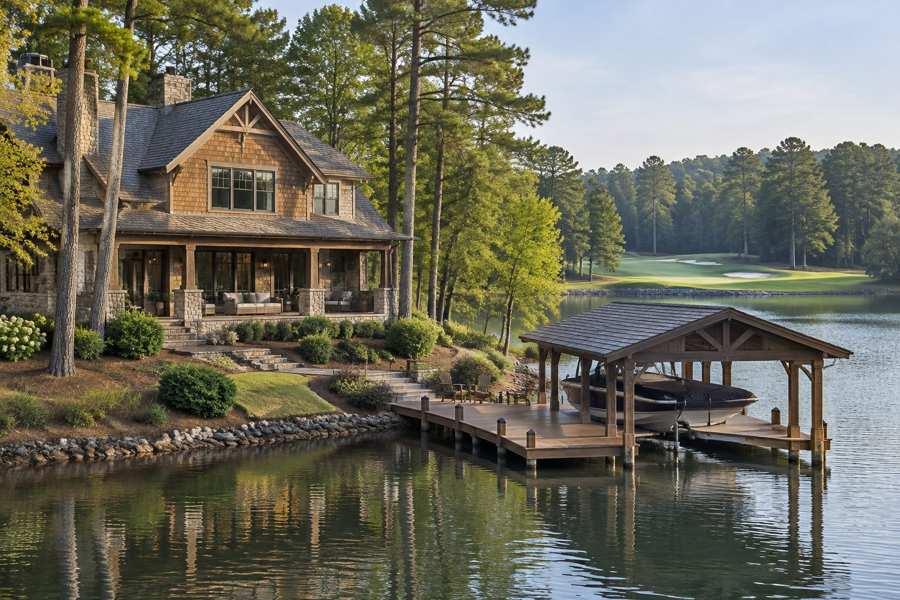
A seller near Lake Oconee is told by the portals that the market cooled. A Greensboro brokerage's August 2026 article reports that the median sale price in the postal area that includes Greensboro and most of Reynolds Lake Oconee was $728,000 as of May, down 17.1% from a year earlier, with homes going pending in about 114 days on average. It then says that the number is the least useful fact about the market, because a new owner at Reynolds must buy a club membership on the day of closing, at a price that the listing sheet does not show.
This brief sets that point beside the rest of the record. It reads the Census age and vacancy profile of the postal area, the 2026 reports from three local brokerages, and the club, dock and lease-lot rules they describe. It then asks what a private direct sale changes for an owner who has a home in a club community and would rather not run a long public listing.
The limits are plain. The Census figures describe a postal area that is wider than the town, the reports are brokerage content, and no Realtor.com metropolitan series covers Greensboro in the data used, so this brief does not substitute one. The brief says where each limit applies and does not estimate what any particular home would sell for.
Key Findings
- The article reports a $728,000 median sale price in the postal area as of May 2026, down 17.1%, with about 114 days to pending, and says Reynolds Lake Oconee is a non-equity club whose membership must be acquired at closing, with 2025 initiation fees of $45,000, $90,000 and $135,000 (McPhillips, August 2026).
- A June 2026 report counted 372 active residential listings (up 5.08%), 82 pending sales (up 54.72%), 85 closings (up 21.43%), 86 days on market for homes and an average residential list price of $1,630,936 (up 6.61%) (Lake Oconee Realty, July 2026).
- A mid-year snapshot of the first five months found 190 closed residential sales at a median of $880,000 and an average of $1,334,875, a median of 88 days on market, an average of 94.61% of asking price and 85 expired listings (Cullifer, June 2026).
- In the Census postal area that includes Greensboro, 2,088 of 8,539 housing units (24.5%) have no usual resident, and 5,139 of 6,451 occupied homes (79.7%) are owner-occupied (U.S. Census Bureau, 2020-2024).
- A local guide says the strongest listing window is late March through May, and that Masters week can draw out-of-town visitors (Boatright Realty Group, June 2026).
What does the club buy-in do to the sticker price?
The August article calls it the line item most buyers miss until the closing table. Reynolds Lake Oconee is a non-equity club, it says, and every new owner is required to acquire a membership on the day of closing. The seller's membership does not transfer. Under the 2025 membership plan, initiation costs $45,000 for the Silver tier, $90,000 for Platinum and $135,000 for The Reserve, with monthly dues on top. A buyer who skips the membership at closing, the article says, leaves the property without future eligibility, which hurts resale.
That rule changes how to read a median. A cottage listed at $850,000 inside the club is not competing with an $850,000 house elsewhere at the lake. It is competing with itself plus a five- or six-figure buy-in that the listing field does not show. A fall 2026 golf course opening, the article adds, is exclusive to Reserve members, so a buyer who wants it faces $135,000, not $45,000, before any dues.
A simple example shows the size of the effect. Take two homes that each list at $850,000. If a buyer must also pay $90,000 for the middle membership tier, the true entry cost of the club home is $940,000, which is 10.6% above its sticker. At the lowest tier of $45,000 the gap is 5.3%, and at the top tier of $135,000 it is 15.9%. These are arithmetic on the article's fee figures, not a prediction of any offer, and they leave out monthly dues.
Seen this way, a 17.1% fall in the median is partly a statement about the mix of homes that sold, and partly an illustration of why the sticker price says little. The article's own summary is that the median dropped while the true entry cost for a buyer with Reserve intent rose in 2026. Two facts, same market, opposite directions.
For a seller inside a club community, the implication is direct. The buyer will price the buy-in into the offer, and every dollar of initiation is a dollar the buyer does not pay for the house. An owner who knows the current tier fees can see how much of a buyer's budget the club absorbs. An owner outside the club, in a community with no mandatory membership, is selling against that handicap.
Source: Madi McPhillips, August 6, 2026. Membership plan details are the article's statements and were not checked against the club's own documents.
What do three budget bands buy?
The same article avoids a single median and sets out three budget bands that behave differently. From the low $300,000s to the $700,000s, it says, buyers find active-adult villas and ranch plans where exterior maintenance is included and short-term rentals are restricted, smaller new cottages starting in the $400,000s, and homes in a lake-access community with no mandatory club membership. Interior club product appears in this band only if the buyer budgets separately for the lowest initiation tier.
From $800,000 to $2 million, it lists lake-access and waterfront homes in a harbor community, golf-side homes in a second club, and interior and golf-front homes inside Reynolds with the middle tier in play. It cites a March 2026 broker analysis that put average Reynolds sales with club access near $1.15 million and a second club with social membership near $875,000. From $2 million up, it lists golf-and-deep-water estates in a range of $1.5 million to more than $6 million, custom builds and trophy properties, with point lots and true deep-water frontage at the very top.
The article's sharpest remark is that the bands are proxies for which club and which shoreline, not for quality. A $700,000 villa and a $700,000 interior cottage look identical on a spreadsheet and produce nearly opposite ownership experiences. For a seller, that means the right comparison is another home in the same community and the same tier, and nothing else.
The mid-year snapshot from another brokerage agrees on the spread. It reports a closed median of $880,000 and an average of $1,334,875 for the first five months of 2026. The distance between those numbers, almost $455,000, is the same pattern seen in other markets in this series, where a few expensive sales lift the average.
Source: Madi McPhillips, August 6, 2026; Justin Cullifer, June 2, 2026. Brokerage content, not independently verified.
What are lease lots and dock rules, and why do they matter?
The August article says certain neighborhoods inside Reynolds sit on Georgia Power lease lots and not fee-simple land. That means an annual lease payment for as long as the owner holds, and it limits what can be done with docks and boathouses. It advises buyers to ask early, because it is one of the most consequential facts about a property and is not always disclosed in a listing headline.
Dock rights get the same treatment. The article says Georgia Power caps boat length on the lake at 30 feet 6 inches, prohibits houseboats and requires permits for any new or expanded dock. In two of the community marinas, slip and dry-stack access run through the marina, and at Reynolds, marina access flows through the club tier the buyer purchases. A lake-access home with a marina waitlist, the article says, is a different asset from one with an assigned slip and a fee-simple dock, and the price should reflect the gap.
Lease terms deserve one more sentence. A buyer cannot value a payment that has not been disclosed, so the usual response to a missing lease figure is a lower offer or a longer inspection period. The seller who has the lease document at hand, with the amount, the renewal terms and the dock permit, turns an unknown into a known number, and buyers tend to discount unknowns more heavily than known costs.
These are rules a seller can check in advance. Is the lot fee simple or leased, and what is the lease payment? Is the dock permitted and who holds the slip? What tier of membership does the home carry or require? An owner who has the answers on one page removes three questions that otherwise arrive one at a time and each lowers the offer a little.
A private buyer who purchases homes off the market has usually priced these items before making an offer. That is not a guarantee of a better price. It means the questions are answered at the start, and the seller is not asked to concede a credit at the end.
Source: Madi McPhillips, August 6, 2026. Lease and dock rules are the article's statements and were not checked against the utility's own documents.
Who lives here, and how many homes are empty?
The postal area has 15,343 residents and 8,539 housing units, of which 6,451 are occupied. Owners occupy 5,139 (79.7%) and renters occupy 1,312 (20.3%). The other 2,088 units, 24.5% of the total, have no usual resident, which fits a lake and golf community where a large share of homes are second or weekend homes. Median household income is $95,527 and median gross rent is $997 a month, or $11,964 a year, which takes 12.5% of the median income.
Owners estimate the median home at $496,400, with a margin of error of $49,293, about 9.9%. That is far below the median sale price of $728,000 and the closed median of $880,000, which tells how different the lake homes are from the postal area as a whole. The area includes the town of Greensboro and rural land as well as the club communities, and the full-time residents there live in cheaper homes than the second-home buyers do.
By age, the 2000s are the largest decade with 1,958 units (22.9%), followed by the 2010s with 1,778 (20.8%) and the 1990s with 1,668 (19.5%). Since 2020, 469 units (5.5%) have been built. Homes built before 1980 are 1,945, or 22.8%, and the median year built is 2000. A stock that is mostly twenty-five years old or less is built on the lake boom, and it is not full of teardown candidates.
For an owner, the combination of high vacancy and a young stock means competing listings are mostly second homes whose owners do not need to sell. That helps explain the 114 days to pending and the 17.1% decline in the median: buyers can wait, and so can many sellers.
| Indicator | Value | Note |
|---|---|---|
| Population | 15,343 | Whole postal area |
| Housing units | 8,539 | All units |
| Owner-occupied homes | 5,139 | 79.7% of occupied |
| Renter-occupied homes | 1,312 | 20.3% of occupied |
| No usual resident | 2,088 | 24.5% of all units |
| Median household income | $95,527 | Estimate |
| Median gross rent | $997 | Monthly |
| Owner-estimated median value | $496,400 | Margin of error $49,293 |
Source: U.S. Census Bureau, American Community Survey 2020-2024 five-year estimates, tables B01003, B19013, B25003, B25034, B25064 and B25077.
What do the June and mid-year reports say about the clock?
The June report from a Lake Oconee brokerage describes a market gaining momentum. Average active residential listings reached 372, up 5.08% from June 2025, and active land listings fell to 94, down 8.74%. Pending sales rose 54.72% to 82, and closings of homes and land rose 21.43% to 85. Residential properties averaged 86 days on market, unchanged from a year earlier, and land averaged 160. The average residential list price was $1,630,936, up 6.61%, and price changes fell 2.21% to 139.
The mid-year snapshot, built from the multiple listing data for January 1 to June 1, looks at the same market from a different angle. It counted 397 homes entering the market and 190 reaching a closed sale, a closed median of $880,000, an average sale price of $1,334,875, a median of 88 days on market and an average final price of 94.61% of the asking price. It also counted 85 listings that expired unsold, just over 21% of the market. As of June 1, active inventory was 243 homes, at an average asking price of $1,724,038 and a median of 66 days on market.
The expired listings are the number to dwell on. Out of 397 homes entering the market, 85 left without selling. That is the cost of a high first price in a market where buyers can wait: a seller who goes to market, waits months and withdraws has lost the time, and may then relist in a market that has seen the house. The average final price of 94.61% of asking shows that those who sold gave up about 5% on average.
Reading the two reports together, the market is active but not fast. Pending sales are up sharply, and the clock for homes is steady at the mid-80s. The 114 days to pending in the postal area is longer than either figure, because the article uses a different area and a different measure. An owner should treat them as three views of a clock that runs from about 66 to about 114 days depending on what is counted.
Source: Lake Oconee Realty, July 1, 2026; Justin Cullifer, June 2, 2026. Brokerage content, not independently verified. Different reports use different areas and measures.
Does timing matter, and what if a seller misses the window?
A local guide says the strongest listing window in Greensboro and nearby Lake Oconee communities is late March through May, in line with national seasonal patterns and with what it describes happening in Greene County. It adds that spring-break travel and warm-weather visits raise the visibility of resort-style and vacation homes, and that Masters week can draw out-of-town visitors because the area lies between Atlanta and Augusta. Early June, it says, can remain workable for lake-oriented listings.
The guide's own caution matters more than its calendar: if a seller misses the spring window, pricing, presentation and launch strategy become even more important. A seller reading this in October is past the window. A house listed now enters the market in the months when visitors are fewest and the tail of unsold homes is longest.
The expired listings from the mid-year snapshot point the same way. A seller who lists in the autumn and does not sell may still be on the market next spring, competing with the new crop of listings. A private sale does not depend on the season. A direct buyer who purchases homes off the market can close on a date the seller picks, which in a second-home market can be the one that suits the owner's own travel.
None of this says that selling in the autumn is a mistake. It says that the calendar is one more variable that a public listing carries and a private sale does not, and that a seller should weigh it alongside the price. Readers comparing markets can also read the Alpharetta brief and the Brookhaven brief.
Source: Boatright Realty Group, June 18, 2026; Justin Cullifer, June 2, 2026. Brokerage content, not independently verified.
What does a private sale change in a club community?
A direct sale to a buyer who purchases homes off the market changes five things. There are no showings and no neighbors talking about you selling, which is the privacy benefit. The closing date can be flexible, giving time to find a new home. There are no commission costs and no closing costs for the seller. And there are no inspections or repairs. In a club community there is a sixth point worth checking, which is that the buyer, not the seller, deals with the membership: the seller's membership does not transfer, and the new owner must acquire one at closing.
The arithmetic of the fee benefit needs no assumed rate. For every 1% of a sale price that would otherwise go to fees, a sale at $728,000 keeps $7,280, a sale at $880,000 keeps $8,800 and a sale at $1,630,936 keeps about $16,309. An owner can set whatever percentage applies against a private offer and compare the two on net proceeds.
The expired-listing figure gives a second yardstick. Out of 397 homes that entered the market in five months, 85 expired. A seller who lists has roughly a one-in-five chance, on those numbers, of leaving the market without a sale. A private offer is a firm number.
The tradeoff is the usual one. A public listing can attract competing bids, and a private sale draws one. In a club community with 82 pending sales in June, a good house at a good price may do well in public. An owner who values privacy, a settled date and freedom from repairs may prefer the private offer. The choice belongs to the owner.
Source: calculation from stated sale prices and counts; no commission rate or closing cost is assumed.
Methodology and limitations
Age, tenure, vacancy, income, rent, population and owner-estimated value come from the American Community Survey 2020-2024 five-year estimates, tabulated for the postal-code area that includes Greensboro. The area is wider than the town and includes club communities and rural land, so the figures describe the area and not the lake homes alone. Shares are calculated from published counts. Owner-estimated value carries a stated margin of error.
No Realtor.com metropolitan series for days on market, inventory, new listings, asking prices or price reductions covers Greensboro in the data used, so none is shown. The market figures come from three local brokerage reports for different areas and periods, which are not directly comparable.
The August article, the June report, the mid-year snapshot and the listing-window guide are brokerage content. Their medians, club fees, lease and dock rules and market counts were not independently verified. The brief makes no forecast and does not estimate what any particular home would sell for.
Conclusion
For an owner in Greensboro, the public record supports a short list of conclusions. A new buyer in a club community pays a membership fee at closing that the sticker price does not show, lease lots and dock rules change the value of a lake home, about a quarter of the area's homes have no full-time resident, listings take from two to nearly four months to go pending, and one listing in five in the mid-year snapshot expired unsold.
It does not support a price for any one home, and it does not support a forecast. The choice between a public listing and a private sale comes down to how much an owner values a possible higher price against privacy, a flexible closing date, no commission, no closing costs and no inspections or repairs.
Frequently Asked Questions
Does the seller's club membership transfer to the buyer?
According to the August article, it does not. The new owner must acquire a membership at closing, at the initiation fee of the chosen tier.
Why is the postal-area median so far below the lake home medians?
The postal area includes the town and rural land as well as club communities, and full-time residents live in less costly homes than second-home buyers.
Is there a regional listing series for Greensboro?
Not in the data used for this brief. The market figures come from local brokerage reports.
Does the season matter?
One local guide says late March through May is the strongest window. A house listed in the autumn faces fewer visitors.
Does a private sale always beat a public listing?
No. A public listing can attract competing bids and sometimes a higher price. A private sale offers privacy, a flexible closing date, no commission, no closing costs and no inspections or repairs, in exchange for a single offer.
Compare your options before committing. Request a written private offer for your property, with no obligation, then weigh it against your listing plan.
Sources
- Madi McPhillips, 2026. Lake Oconee Home Prices 2026: What Does Your Money Buy?. https://madimcphillips.com/blog/reading-the-lake-oconee-median-what-your-money-actually-buys-in-late-2026.
- Lake Oconee Realty, 2026. Lake Oconee Real Estate Market Report, June 2026. https://www.lakeoconee.realty/blog/lake-oconee-real-estate-market-builds-momentum-as-buyer-activity-accelerates-in-june-2026/.
- Justin Cullifer, 2026. The Tale of Two Realities: a Mid-Year Lake Oconee Real Estate Market Snapshot. https://nextluxuryhome.com/blog/the-tale-of-two-realities-a-mid-year-lake-oconee-real-estate-market-snapshot.
- U.S. Census Bureau, 2026. American Community Survey 2020-2024 five-year estimates, the Greensboro area (via Census Reporter). https://censusreporter.org/profiles/86000US30642-30642/.
- Boatright Realty Group, 2026. When To List Your Greensboro Or Lake Oconee Home. https://boatrightrealtygroup.com/blog/when-to-list-your-greensboro-or-lake-oconee-home.
Related research
Seller Guide · October 6, 2026
How to Prepare Point Pleasant Beach Rental Records Before Selling
Separate rental approval, income history and booked stays before comparing sale terms.
Seller Guide · October 6, 2026
How to Prepare Rumson Flood and Waterfront Records Before Selling
Separate flood disclosure, elevation, repairs and waterfront rights before comparing sale terms.
Seller Guide · October 6, 2026
How to Prepare Sarasota Condo Inspection and Reserve Records Before Selling
Separate building condition, reserve funding and resale documents before comparing sale terms.