Seller Guide · by Aidan Sowa · 2026-10-07
How to Prepare Kirkland Tree and Slope Records Before Selling
Connect tree history, mapped hazards and approved site plans before promising yard changes.
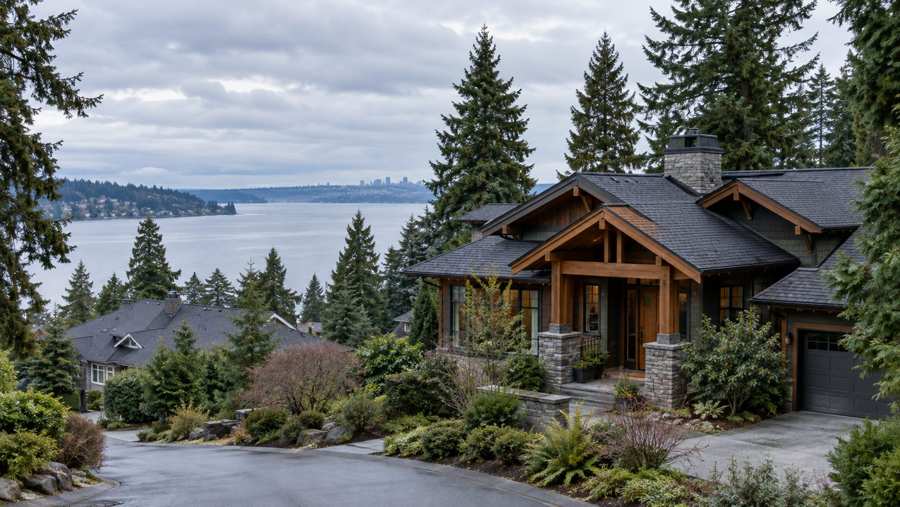
A Kirkland seller should assemble tree history and slope records before promising a cleared view, a larger yard or an easy future addition. Removing vegetation as sale preparation can change the next owner's permit timeline, and a mapped hazard is a screening flag rather than an engineering conclusion. Start with the parcel, then connect individual trees, prior work and approved plans to the records that actually exist.
Kirkland's Trees and Urban Forestry page states a goal of forty percent tree canopy cover and regulates trees at six inches diameter at breast height or greater. Those are citywide policy and regulatory measures, not a finding that a particular home has forty percent canopy or six removable trees. This guide explains how to assemble a sale packet, distinguish removal routes and preserve questions for qualified professionals before comparing written offers.
Start With the Parcel Rather Than the Postal Address
Identify the actual parcel, city jurisdiction, zoning and mapped constraints before describing what a buyer can change. A Kirkland postal address alone is not a complete permit analysis. The city's planning resources explain how to inspect zoning and critical area layers, while its maps remain screening tools. Save the address, parcel identifier and dated map views alongside the records used to interpret them.
The City of Kirkland's Planning Frequently Asked Questions directs owners to its interactive GIS for zoning, streams, wetlands and steep slopes. It explains that selecting a parcel produces site information and a zoning link. Use that as a starting index, not as a substitute for a survey, a recorded restriction or an issued approval.
Parcel file: Record the legal description, parcel identifier, zone, applicable overlays and which agency handled previous work. A home marketed as Finn Hill may also raise Holmes Point Overlay questions; the city's Tree Retention Plans for Developments Checklist identifies that overlay as having additional requirements. Do not apply an ordinary developed-lot tree allowance until those conditions have been checked.
Boundary example: A tree beside the driveway may look like a private yard tree but sit in the public right-of-way. Kirkland's Trees and Urban Forestry page requires a permit before pruning or removing public trees, including right-of-way trees. Preserve a survey or other boundary evidence rather than treating who has maintained the tree as proof of ownership.
Use Hazard Maps to Identify Questions, Not Certify Safety
Use the city's slope, landslide and sensitive-area maps to locate issues that need a closer look. A map does not establish that a property is safe or unsafe, and the absence of a mapped feature is not a clearance. Geologic hazards and wetland boundaries require site-specific evidence under the relevant code. Keep the map date and the professional findings separate.
Kirkland Zoning Code section eighty-five point twelve calls the maps "a screening tool" and says hazard presence and risks must be determined through site-specific studies such as a geotechnical investigation. It also says the code, report findings and city review take precedence over city mapping. A seller should not turn a blank layer into a promise that grading or an addition will be uncomplicated.
The City of Kirkland's GIS Maps page describes its topography map as showing ten-foot contour intervals and its landslide map as showing susceptibility to deep or shallow landslides. These are regional information products. They are different from the site survey required for a particular proposal, so label them as screening exhibits in the sale packet.
The city's Critical Area Regulations page states "Maps are for reference only." For wetlands, it says a professional wetland ecologist is required to determine location, size, quality and functions before development can be reviewed and permitted. Preserve the underlying study if one exists; do not claim that a lawn, fence or existing building establishes the regulated boundary.
Inventory Trees and the Work Already Done
Create a dated inventory that connects each regulated tree to its size, location, condition evidence and prior removal history. Kirkland distinguishes ordinary regulated trees from landmark trees and considers property size, remaining trees and recent removals. An inventory organizes the questions; it does not itself grant permission. Include existing mitigation trees and recorded protections rather than counting only trees a buyer wants removed.
Kirkland's Trees and Urban Forestry page identifies landmark trees at twenty-six inches diameter at breast height or greater. The City's Tree Code Quick Facts repeats that landmark trees have special protection requirements and explains that special conditions such as critical areas and recent development affect removal allowances. Keep measurements and the date of assessment instead of estimating diameter from a photograph.
Under Kirkland Zoning Code section ninety-five point twenty-five, developed lots up to ten thousand square feet have an ordinary allowance of two regulated-tree removals per twelve months with two regulated trees remaining. Lots from ten thousand one to twenty thousand square feet have a three-tree allowance and three remaining; larger lots have a four-tree allowance and four remaining. These numbers are subject to the other requirements, not permission to cut every tree up to the count.
History file: Save removal notifications, permits, approval conditions, dates of actual removal, replacement planting records and any recorded protection documents. If a previous owner removed trees and the date is unknown, record that uncertainty. A new owner should not assume that a sale resets a property-based history or removes the need to check applicable city standards.
Distinguish a Notification From a Permit or Development Review
Choose the tree review route from the actual conditions and intended work, not from the size of the contractor's job. Ordinary developed-property notifications have limits, landmark trees require permits, and critical areas or recent development can change the route. Development-related tree review is separate from routine yard maintenance. Preserve the issued decision and conditions for the route that actually applied.
Kirkland Zoning Code section ninety-five point twenty-five states "No person, directly or indirectly, shall remove any regulated tree from private property without first submitting a tree removal notification form." Its permit provisions and special categories must be read with that requirement. The city's Trees and Urban Forestry page lists the conditions for using a notification, including no landmark tree, no mapped critical area and compliance with allowance and remaining-tree requirements.
Comparison limit: The table summarizes review paths, not fees, a parcel determination or approval. Public trees and emergency threats follow separate city procedures; a normal sale-preparation request should not be relabeled an emergency. An arborist recommendation also does not replace the city decision where one is required.
For a buyer planning construction, Kirkland Zoning Code section ninety-five point thirty applies tree retention plans to specified development permits unless an exemption applies. Its exemption for certain additions and remodels combines an improvement footprint below fifty percent with no development activity in regulated trees' critical root zones. Passing the percentage test alone does not establish the exemption.
| Route | Typical context | Evidence to retain | Main limitation |
|---|---|---|---|
| Private notification | Ordinary regulated trees on a developed lot | Submitted notification, inventory and removal dates | Allowances, remaining trees and special conditions still apply |
| Private tree permit | Landmark trees or other permit-triggering conditions | Arborist evidence, issued decision and mitigation conditions | A requested removal is not an approved removal |
| Critical area tree review | Wetland, stream, buffer or high landslide setting | Qualified reports, city decision and replacement plan | Snag, root retention and replacement rules may apply |
| Development tree retention | Work requiring the relevant development approvals | Current tree inventory, arborist report and coordinated site plans | A maintenance allowance does not replace development review |
| Public tree permit | Trees on public land or in the right-of-way | Boundary evidence and public tree authorization | Private ownership of the nearby home does not authorize work |
Check Removal Dates Before Promising an Addition
Check the removal history before advertising immediate development potential. Kirkland imposes specified waiting periods after healthy regulated or landmark tree removals outside development review, with exceptions and conditions in the code. A seller's choice to improve a view may therefore affect a future permit application. Preserve the dates and city correspondence and ask how the rule applies to the actual project.
Kirkland Zoning Code section ninety-five point twenty-five bars acceptance of development applications while a tree removal permit or notification is pending, except for approved hazard or nuisance removals. For detached dwelling units, middle housing, short plats or subdivisions, it specifies twelve months after the most recent regulated-tree removal or twenty-four months after the most recent landmark-tree removal. The city's Trees and Urban Forestry page also flags this development hold.
The code includes a director-reviewed exception for unusual and extraordinary circumstances, with supporting information and an owner declaration. That is a review path, not an assurance that a sale or a buyer's change of plans qualifies. Preserve the actual exception decision if issued instead of presenting the existence of an exception as immediate permission.
Timing example: A seller considering healthy-tree removal shortly before marketing a redevelopment property should first check whether the work will affect application acceptance. Compare keeping the tree and documenting its condition with removing it under the appropriate process. No removal occurred for this guide, and no waiting period was calculated for a private property.
Keep Arborist Findings Separate From a Tree Work Bid
Use a qualified arborist's report for tree condition, risk and retention questions, and keep it connected to the site plan used for review. A contractor's price proposal answers a different question. Kirkland requires information that supports the recommendation, not simply a request to remove a tree. Preserve photographs, tree numbers, methods and alternatives alongside the final city response.
The City of Kirkland's Guide to Arborist Reports states "An invoice or bid for tree work is NOT an arborist report and will not be accepted." It also rejects a hazard evaluation form alone as a substitute for a complete report. This makes the distinction useful in a sale packet: keep the bid for cost discussion and the report for the evidence behind the proposed action.
Kirkland Zoning Code section ninety-five point thirty requires consistent tree numbering across the arborist report, site plan and on-site tags for development tree inventories. It includes adjacent-property trees whose critical root zones appear to extend onto the site. It also requires reports based on fieldwork collected three or more years before submission to be updated with current data.
Review file: Record which plans the arborist reviewed, the report date, assessed health and structure, proposed retention or removal, and replacement recommendations. A report written before a driveway redesign may not describe the current proposal. The city's arborist guide specifically says development reports will not be accepted if the most recent site plans have not been reviewed.
Connect Slope and Critical Area Reports to Approved Plans
Collect geotechnical and critical area studies with the project drawings and city decisions they support. An older report can document a previous proposal without approving a new addition or changed drainage. Tree retention, groundcover and replacement obligations may be part of hazard mitigation. A useful sale packet shows which recommendations became conditions and which construction or final reports remain outstanding.
Kirkland Zoning Code section eighty-five point nineteen distinguishes an investigation to determine whether a geologic hazard exists from a development report with hazard analysis and recommendations. Its survey provisions describe two-foot contour intervals, with slopes at fifteen percent or greater delineated and slopes at forty percent or greater identified. Those are report requirements, not a simple safe-versus-unsafe slope cutoff.
Kirkland Zoning Code section eighty-five point twenty-five allows the city to require geotechnical recommendations, professional plan acknowledgment, on-site observation, a final compliance report and engineered foundation or retaining-wall designs. Keep these instruments together. A final report from an earlier retaining wall should not be presented as certification for every slope or future project on the parcel.
Kirkland Zoning Code section ninety point one hundred ten says critical area reports must be prepared by a qualified critical area professional and addresses city or consultant review. It reaches relevant off-site features as well as the subject lot. Report scope: Preserve the mapped boundary, field findings, buffers, assumptions, project description and reviewing decision so buyers can see what was actually studied.
Preserve Vegetation and Replacement Obligations in the Handoff
Include the vegetation that must remain, the trees that must be replaced and the recorded conditions that continue with the property. Removing a hazardous tree may not authorize clearing its roots or nearby groundcover. Critical areas and high landslide settings have special rules. Separate completed mitigation from an open obligation, and avoid treating a planting minimum as permission to remove protected existing trees.
Kirkland Zoning Code section ninety-five point twenty-eight directs high landslide tree pruning and removal to section ninety-five point twenty-seven. It prohibits removal of shrubs and groundcover in a high landslide hazard area without prior city approval and generally requires stabilization and vegetation replacement within sixty days unless the Planning Official determines otherwise. The ordinary tree allowance does not bypass that rule.
Kirkland Zoning Code section ninety-five point twenty-seven addresses snag creation, felled trees and retention of stumps and supporting roots, subject to its conditions and city determinations. For high landslide hazard trees qualifying for removal, it specifies retaining the stump and root system. Its replacement rule starts at three native or climate-ready trees, with further size, species and location requirements and possible additional replacements.
Kirkland Zoning Code section ninety-five point thirty-four states "This section does not establish a maximum retention standard for existing trees." Its minimum replanting density of fifty tree credits per acre for listed residential development does not erase other retention requirements. Final handoff: Assemble parcel screening, inventory, removal chronology, qualified reports, approved plans, actual decisions and unfinished obligations; describe missing documents plainly rather than promising future approval.
Frequently Asked Questions
These questions reflect Kirkland's published planning guidance and current zoning code rather than a private tree inventory or engineering assessment. They explain distinctions between screening, professional reports and city approval, and why removal dates matter before sale preparation. A qualified professional and the city must resolve the applicable route, hazard findings and proposed work for a particular parcel.
Can I remove trees to improve the view before selling?
Check the applicable tree route and removal history before arranging work. Healthy-tree removal can affect specified future development application timelines under Kirkland Zoning Code section ninety-five point twenty-five.
Is a large tree automatically a landmark tree?
Kirkland identifies landmark trees at twenty-six inches diameter at breast height or greater. Preserve the measurement and check special conditions rather than relying on apparent height or crown size.
Does the ordinary allowance mean no paperwork?
No, the ordinary developed-lot allowance still requires a submitted notification and compliance with its conditions. Landmark, critical area and other permit-triggering circumstances follow different requirements.
Can I rely on the city landslide map alone?
No, the code calls mapping a screening tool. Site-specific investigation and city review establish geologic hazard findings for the relevant proposed activity.
Is a tree removal estimate enough to show a hazard?
No, Kirkland's arborist guide says a bid is not an arborist report. Preserve the professional risk evidence and the city's decision rather than turning a price quote into permission.
Will a buyer be able to apply for construction immediately after removal?
Not necessarily, because the code names waiting periods for specified development after recent healthy-tree removals. Check the actual removal date, tree category, proposed development and any issued exception.
Can a stump be removed once the city approves the tree?
Not automatically, particularly in critical area or high landslide settings. The applicable rules and issued conditions can require the stump and supporting root system to remain.
Does an old arborist report cover a new addition?
Check its fieldwork date and whether the latest project plans were reviewed. Development tree reports based on fieldwork three or more years old must be updated under section ninety-five point thirty.
Does a direct sale remove permit or mitigation obligations?
No, a sale route is separate from public regulatory duties and recorded conditions. Compare actual written terms without promising that a purchase removes unresolved tree or slope issues.
How Maison Off-Market Fits a Tree and Slope Record Handoff
Maison Off-Market offers a direct-purchase route that an owner can compare once tree and slope records are organized. Its public process assesses the home and land and may produce an offer if the property fits. That is not an arborist opinion, geotechnical certification or city approval. Compare actual written terms while keeping the record gaps and continuing obligations visible.
Maison Off-Market's public process says "We assess the home and the land" and includes lot size, zoning and what a buyer could build in that assessment. It also says "If it fits" before describing a direct purchase offer. Those statements describe the service's process, not a private Kirkland offer, guaranteed development result or technical slope finding.
Compare written terms: Maison Off-Market's current hosted site describes privacy without showings, no commissions or closing costs, and no seller repair work. It adds that buyer inspections and disclosures remain subject to applicable law and written terms. Treat these as published service claims to compare with an actual proposal, not proof of the value or condition of this property. A direct sale does not replace issued permissions, satisfy tree replacement conditions or certify a future addition.
Compare your options before committing. Request a written private offer for your property, with no obligation, then weigh it against your listing plan.
Sources
- City of Kirkland, Checked October 2026. Trees and Urban Forestry. https://www.kirklandwa.gov/Government/Departments/Planning-and-Building/Trees.
- City of Kirkland, Checked October 2026. Planning Frequently Asked Questions. https://www.kirklandwa.gov/Government/Departments/Planning-and-Building/Planning-Frequently-Asked-Questions.
- City of Kirkland, Checked October 2026. Tree Code Quick Facts. https://www.kirklandwa.gov/files/sharedassets/public/v/1/planning-amp-building/trees/tree-code-faq.pdf.
- City of Kirkland, Checked October 2026. GIS Maps. https://www.kirklandwa.gov/Government/Departments/Information-Technology/GIS-Maps.
- City of Kirkland, Checked October 2026. Critical Area Regulations. https://www.kirklandwa.gov/Government/Departments/Planning-and-Building/Critical-Area-Regulations.
- City of Kirkland, Checked October 2026. Guide to Arborist Reports. https://www.kirklandwa.gov/Government/Departments/Planning-and-Building/Trees/Arborist-Reports-Guide.
- City of Kirkland, Checked October 2026. Tree Retention Plans for Developments Checklist. https://www.kirklandwa.gov/files/sharedassets/public/v/3/planning-amp-building/trees/tree-retention-plans-for-developments-checklist.pdf.
- City of Kirkland Zoning Code, Checked October 2026. Private Property Tree Removal, Section 95.25. https://kirkland.municipal.codes/KZC/95.25.
- City of Kirkland Zoning Code, Checked October 2026. Trees in Critical Areas and Buffers, Section 95.27. https://kirkland.municipal.codes/KZC/95.27.
- City of Kirkland Zoning Code, Checked October 2026. Trees and Vegetation in Geologically Hazardous Areas, Section 95.28. https://kirkland.municipal.codes/KZC/95.28.
- City of Kirkland Zoning Code, Checked October 2026. Tree Retention Associated With Development Activity, Section 95.30. https://kirkland.municipal.codes/KZC/95.30.
- City of Kirkland Zoning Code, Checked October 2026. Tree Replacement Standards, Section 95.34. https://kirkland.municipal.codes/KZC/95.34.
- City of Kirkland Zoning Code, Checked October 2026. Critical Area Maps, Section 85.12. https://kirkland.municipal.codes/KZC/85.12.
- City of Kirkland Zoning Code, Checked October 2026. Required Geologic Hazard Information, Section 85.19. https://kirkland.municipal.codes/KZC/85.19.
- City of Kirkland Zoning Code, Checked October 2026. Geologic Hazard Performance Standards, Section 85.25. https://kirkland.municipal.codes/KZC/85.25.
- City of Kirkland Zoning Code, Checked October 2026. Critical Area Report, Section 90.110. https://kirkland.municipal.codes/KZC/90.110.
- Maison Off-Market, Checked October 2026. Public Process. https://bulkscaler.com/.
- Maison Off-Market, Checked October 2026. Current Hosted Public Process. https://files.instinct.com/zp8jmzhzb6oc-luxury-off-market-buyer-website.
Related research

Seller Guide · 2026-10-09
How to Assemble South Naples Flood Map and Repair Sale Records
Match effective maps, elevation evidence and approved repair records before presenting a sale file.
Seller Guide · 2026-10-09
How to Prepare Newton Tree Permit and Protection Sale Records
Separate removal permits, exemptions, arborist assessments and replacement obligations before selling.
Seller Guide · 2026-10-09
How to Organize Sevierville Well and Spring Water Sale Records
Separate the water source, construction report, test results and service history before selling.